Let  . We say that two smooth foliations F, G of codimension 1 in
  are orthogonal if for any
  , the leaves X, Y of F, G passing through p are orthogonal at p.
Dupin’s theorem. Let  be a d-tuple of mutually orthogonal foliations of codimension 1 in . Let , let
  denote the leaf of
  passing through p, and let
 . Then
  is tangent to a principal curvature vector of
  at p whenever
  .
.
This theorem is well-known in dimension  , but it was brought to my attention by Hyunwoo Kwon that there does not seem to be a good reference if
  . This appears to be for superficial reasons: the usual proof is based on properties of the cross product which clearly only hold when . I call this a superficial reason, because we can easily replace the cross product with the wedge product, and then the argument will work in general. In this blog post, I will record the proof which works for any dimension . (Actually, it works in case
  as well, but Dupin’s theorem is vacuously true in that case.)
We first check that the conclusion of the theorem makes sense. In fact, is the intersection of  smooth hypersurfaces, each of which are mutually orthogonal and therefore are transverse. So is a smooth curve, and its tangent space at p is a line.
Near p, we can find a coordinate system  such that the level sets of
  are the leaves of . Let g be the euclidean metric tensor written in the coordinates
  . Orthogonality of and
  means that
  . Therefore the cometric
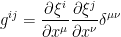
is diagonal; therefore the same holds for the metric
 .
.
Let (i, j, k) be a distinct triple. Differentiating the equation  , we obtain

Thus if we set

then we have the system of equations  ,
,  ,
,  ,
,  ,
,  ,
,  . Here, the first three equations arise from the formula for the differentiated metric and the last three originate from symmetry of second partial derivatives. The only solution of this system of this equation is
  for every distinct triple (i, j, k), or in other words
 .
.
Combining this equation with the equation and the formula for the metric, we see that every vector in the list

(where the roof means to remove that entry from the list) is orthogonal to  . Therefore every vector in L is contained in a vector space of dimension , but the length of L is d, so L is linearly dependent.
Let  be the second fundamental form of
  , written in the coordinate system
 .
.
Then  is equal to a scalar times the Hodge star of the wedge product of all of the vectors in L. Since the wedge product of L vanishes, so does , so is diagonal. Since the metric
  on is given by
  , is also diagonal in the coordinate system
  .
.
It follows that  is a principal curvature vector of whenever
  . But is normal to , so it is tangent to the curve , as desired.

 some compact thoughts